Friday night we flew into Lanzhou. As we approached the city by air I looked out the window and, for as far as the eye could see, were the mountain steppes that are part of the region. It looked like someone had taken the worlds largest bed sheet and crumpled it up/ There were undulating crevices and peaks going towards the distance and all were a dull brown color.
We landed and were met by Dr. Tang ad our driver. Driving into Lanzhou was different than driving into Shanghai or Changchun. It was a long drive (almost an hour) through the steppe hills - a backdrop of low mountains that went on for as far as the eye could see, all of which had been terraced to have ruler straight lines of trees planted all up the hillside. Lanzhou is an arid area that, through deforestation, has taken on an almost desert-like appearance outside of town. Someone in the government decided that a major reforestation project was due. How they will water, literally, millions of trees in an arid semi-desert - I haven't a clue.
Once we landed and got into town it was dark - but we were taken directly to a restaurant where we were joined by one of our translators - Fiona - who has worked with Children's HeartLink visiting teams for over 4 years. She is a nurse and quite fluent in English, thanks to her love of American sitcoms and "Lie to Me - on Fox!" Lanzhou has always been home to many ethnic minorities, from Buddhists in the early ages to a quite sizable Muslim population now. That meant fantastic lamb and beef and no need for me to worry about pork or shellfish! Honestly, this first meal was one of the best I have had. While not the spicy Szechuan food, it had a lot of flavor and was spicy. We had several types of lamb, which were all fantastic.
The next morning we went to the hospital and got to meet Dr. Tang's colleagues - Dr. Bin, Dr. Song, and others, as well as the former chair of the department, Dr. Gau, and the VP of the hospital, and long time supporter, Dr. Yu. The hospital in Lanzhou is connected to a university, so it is a teaching hospital. And they take a lot of pride in this. They are warm, caring, earnest people. I would say they are simple, but hat sounds condescending. It is not. They are aware of what their mission and job is and they work diligently and hard to accomplish it with all of their considerable thought, talent, and spirit. They were, to a person, open, inviting, and genuine.
The city itself was an interesting change from Changchun. Less Soviet looking (but some small influences) and more "traditional Chinese" - with lots and lots of people all over and immense traffic. But it is clearly a city modernizing as well. We went to the mall the next day and it reminded me of the Water Tower in Chicago.
I've mentioned before that driving in China is an adventure. Lanes and lines mean little. People compete with cars and don't back down. Drivers veer from lane to lane, like a weaver at a loom. Crossing a double yellow line and playing chicken with oncoming traffic is common - especially if the car in front of you is slow and you want to make that next turn...
Part of the issue with driving in China is the population explosion an subsequent massive building. None of the cities were designed for cars to begin with, so in a sudden growth mode most places just did more of what they had before. Plus, in a city like Lanzhou (3 million people0 there are 300-500 new drivers A DAY.
Then there is the driving itself. In order to get a license in China you have to take over 50 hours of instruction. Or be willing to pay a premium to just get your license. If you can afford it, you do that latter. The former isn't so great to begin with, apparently. Nearly every 20 or 30 year old we have met - doctors, nurses, translators - do not drive themselves. Some are practicing for their license, most are not. Chinese who move to the States for a time get their American driver's license, but refuse to drive in China. But you better get it while you can, because in China if you are over 70 it is illegal to drive.
And then there's the issue of learning. Very few parents have ever driven, so are unable to help teach their children the rules of the road. It is a significant cultural and generational gap.
The best way, I have found, to be a passenger in China, is to close your eyes. Which, sadly, seems to be the way a lot of people drive here...
Sunday, April 10, 2011

Thursday, April 7, 2011
Individualization in China OR How to Stand Out In A Country of Billions OR Why I Could Never Buy Shoes Here
Today was a relatively simple day, visiting our partner site here - the Jilin Heart Hospital. Jilin is under construction, and has been for some time, due to the weather, a scarcity of skilled workers in the area able to do the construction work, and other reasons. They are building what will ultimately be (according to Estelle) one of the most advanced cardiac care centers in the developing world. We spent a lot of time touring the facility and meeting with their staff to discuss the transition plan to the new facility.
So, with minimal running around and several trips back and forth through a busy city center, I had time to reflect on some of the things I've seen, heard, and experienced on the trip so far.
China is big. Land wise, yes, but in terms of population it is huge also. 1.3 billion people. That's a B at the beginning. The population of the United States is roughly 310 million. So China has at least 4 times as many people in it. And, as I've mentioned before, there has been a boom in city living. While traditionally an agricultural country, in the last 20 years the population has reversed so that now 2/3 of the country is living in urban environments and 1/3 are living in the country. That means there is a greater population of Chinese living in the countryside than there are people in the entire United States. But it also means that a population almost 3 times the size of the entire United States is now living in cities. And most of those people are new to the cities. This explains the explosion of huge cities, the building boom, the massive expansion of cars (and inhumanely bad driving habits of their drivers...)
And there are no suburbs. Everyone lives in the city in apartments. Cities continue to grow and grow. So apartment buildings don't go up - apartment villages do. Several - sometimes a dozen - identical buildings made to house people - shiny and new - appear virtually overnight, every night. There is never just one of anything and they are never simple or bland. They are temples to modernity with glass and height and sleekness. And over every finished skyscraper stands a construction crane.
So how does one stand out - show individualization - when everything being built - apartment buildings, cars - are mass produced and the same? One way is to be a six foot tall non-Asian with a shaved head and size 12 shoes. Twice now I've been reminded how rare this is. When at the SCMC they wanted to take us back to see their operating theater. We had to put covers over our shoes. But the plastic covers wouldn't fit my shoes. They couldn't find any that would. Their world isn't made for size 12's. And at every hotel they provide complimentary slippers for you to walk around your room in - a historic cultural custom. After arriving in Changchun I decided to treat myself - relax, put on some slippers. If only I could get my feet into them. I don't fit the mold of the average size Asian apparently...
So, if you're not me, how do yo stand out and individualize? One way is through what you own. Chinese love luxury goods. They buy them up as fast as they'll come out. And they come out fast, so that people have to buy the latest. Some are simply horrifying, but as long as their the newest and the most expensive, they'll be bought. They may have the same apartment as the person next to them, but, by god, theirs will be decorated nicer (???) or newer. Fashion, also, plays a unique role, as do hair styles (and colors) and ring tones. Everyone is trying to have the newest, flashiest of each. So, of course, the bar keeps being pushed further and further. Walking down a Shanghai street is like a day at preschool when the toddlers are allowed to dress themselves. An explosion of color, pattern, and style begging for attention and there just because they can.
I guess, when you're competing for individuality against 1.3 billion other people, you do what you can to stand out. As Li, our friend from Medtronic traveling with us in Changchun, said to Estelle and I this morning - every problem [or issue] in China is overwhelming and miniscule. Take any one problem a person may have and multiply it by 1.3 billion and it is overwhelming. But take any societal issue or challenge and divide it by 1.3 billion and it is infinitesimally small. It is all about perspective here and nothing in China stays the same for long, no answer is absolute, and no one knows what is coming next.
Except for me. I know on this trip I won't be able to buy a pair of shoes that fits me here.
 |
| Jilin Heart Hospital - Under Construction |
So, with minimal running around and several trips back and forth through a busy city center, I had time to reflect on some of the things I've seen, heard, and experienced on the trip so far.
China is big. Land wise, yes, but in terms of population it is huge also. 1.3 billion people. That's a B at the beginning. The population of the United States is roughly 310 million. So China has at least 4 times as many people in it. And, as I've mentioned before, there has been a boom in city living. While traditionally an agricultural country, in the last 20 years the population has reversed so that now 2/3 of the country is living in urban environments and 1/3 are living in the country. That means there is a greater population of Chinese living in the countryside than there are people in the entire United States. But it also means that a population almost 3 times the size of the entire United States is now living in cities. And most of those people are new to the cities. This explains the explosion of huge cities, the building boom, the massive expansion of cars (and inhumanely bad driving habits of their drivers...)
And there are no suburbs. Everyone lives in the city in apartments. Cities continue to grow and grow. So apartment buildings don't go up - apartment villages do. Several - sometimes a dozen - identical buildings made to house people - shiny and new - appear virtually overnight, every night. There is never just one of anything and they are never simple or bland. They are temples to modernity with glass and height and sleekness. And over every finished skyscraper stands a construction crane.
So how does one stand out - show individualization - when everything being built - apartment buildings, cars - are mass produced and the same? One way is to be a six foot tall non-Asian with a shaved head and size 12 shoes. Twice now I've been reminded how rare this is. When at the SCMC they wanted to take us back to see their operating theater. We had to put covers over our shoes. But the plastic covers wouldn't fit my shoes. They couldn't find any that would. Their world isn't made for size 12's. And at every hotel they provide complimentary slippers for you to walk around your room in - a historic cultural custom. After arriving in Changchun I decided to treat myself - relax, put on some slippers. If only I could get my feet into them. I don't fit the mold of the average size Asian apparently...
So, if you're not me, how do yo stand out and individualize? One way is through what you own. Chinese love luxury goods. They buy them up as fast as they'll come out. And they come out fast, so that people have to buy the latest. Some are simply horrifying, but as long as their the newest and the most expensive, they'll be bought. They may have the same apartment as the person next to them, but, by god, theirs will be decorated nicer (???) or newer. Fashion, also, plays a unique role, as do hair styles (and colors) and ring tones. Everyone is trying to have the newest, flashiest of each. So, of course, the bar keeps being pushed further and further. Walking down a Shanghai street is like a day at preschool when the toddlers are allowed to dress themselves. An explosion of color, pattern, and style begging for attention and there just because they can.
I guess, when you're competing for individuality against 1.3 billion other people, you do what you can to stand out. As Li, our friend from Medtronic traveling with us in Changchun, said to Estelle and I this morning - every problem [or issue] in China is overwhelming and miniscule. Take any one problem a person may have and multiply it by 1.3 billion and it is overwhelming. But take any societal issue or challenge and divide it by 1.3 billion and it is infinitesimally small. It is all about perspective here and nothing in China stays the same for long, no answer is absolute, and no one knows what is coming next.
Except for me. I know on this trip I won't be able to buy a pair of shoes that fits me here.
Wednesday, April 6, 2011
Final Day - And Thoughts - On Shanghai and First Impressions of Changchun
When we woke up this morning something was different in the city. There were people. And cars. And noise. And smells. Shanghai was back - the real Shanghai, not the Shanghai we had been seeing for the past 48 hours. The holiday was over and the city was returning to itself - it's rhythm and pulse had returned.
We went to SCMC once again, but to the heart institute to meet with Drs. Xu, Lu, and Du. These 3 generous, kind, and talented individuals are all cardiac surgeons a the Children's Heart Center. The Children's Heart Center at SCMC is the most advanced and well respected in the country. It is an impressive, modern facility that helps to train many of the doctors and nurses across all of Western China. They have a proud history of creating their own pumps and instruments in the time before China was opened to the West and hold nearly all of the pediatric cardiology firsts. They are so proud - and have so much to be proud of - that they have a museum dedicated to their history and accomplishments in their building. Below is a picture of Estelle with the Drs. in their museum.

The are quite wordly, too. Dr. Lu trained in Boston and DC. Dr. Xu has traveled and spoken in the US several times. hey have all gone to Israel for training. All 3 spoke wonderful English (far better than my Mandarin...) And when I let them know I could not eat pork or shellfish, they didn't hesitate a second before letting the chef know and my ending up with a special meal.
Shanghai is the gleaming new China and I loved it. But it is a crowded, growing city. 3 things illustrated that well:
From there it was off to the airport, a 2.5 flight to Changchun, a 45 minute drive to the hotel, assorted adventures and mix ups, a hotel room swap, and blogging. Fortunately, a friend of Children HeartLink's in China who works for Medtronic - Li - has joined us to help translate. As he said, Changchun is "underdeveloped" which is a euphemism for behind the times. Mind you, this is a city of 3 million people. But all I could think as we drove through it was that it reminded me of Ukraine. In many ways, this is old China - communist China - where buildings all have a certain, similar look. People have a certain, closed, mindset. We couldn't use a credit card because we didn't know our pin (and credit cards don't have pins...), the taxi ride cost us 5rmb (less than a dollar), we couldn't find anyone who spoke English so had to call our host at his home to order dinner. (BTW - the local beer is the lightest and least flavorful I have found yet...)
EDIT: Okay, looking back at my comments now, and having spent a day or two with the residents, while there are a LOT of similarities to Ukraine and there is a communist feel to the city, the people, at least the ones we interacted with at length, are warm, kind, intelligent, working to make a better life for themselves and others, and seriously consider the issues impacting their work, their profession, their country, and the world.
We went to SCMC once again, but to the heart institute to meet with Drs. Xu, Lu, and Du. These 3 generous, kind, and talented individuals are all cardiac surgeons a the Children's Heart Center. The Children's Heart Center at SCMC is the most advanced and well respected in the country. It is an impressive, modern facility that helps to train many of the doctors and nurses across all of Western China. They have a proud history of creating their own pumps and instruments in the time before China was opened to the West and hold nearly all of the pediatric cardiology firsts. They are so proud - and have so much to be proud of - that they have a museum dedicated to their history and accomplishments in their building. Below is a picture of Estelle with the Drs. in their museum.
The are quite wordly, too. Dr. Lu trained in Boston and DC. Dr. Xu has traveled and spoken in the US several times. hey have all gone to Israel for training. All 3 spoke wonderful English (far better than my Mandarin...) And when I let them know I could not eat pork or shellfish, they didn't hesitate a second before letting the chef know and my ending up with a special meal.
Shanghai is the gleaming new China and I loved it. But it is a crowded, growing city. 3 things illustrated that well:
- First, as you walk through the obnoxiously crowded streets you notice that people stick together. 2 men, 2 women, a couple (whether or not they are a "couple") stay very close, hold hands, link arms. Personal space is non existent and people cling to the familiar.
- Second, Dr. Xu told us a story. The hospital is in a very crowded and new part of Shanghai - Pudong Province. It is busy, crowded, filled with skyscrapers, and very shiny. 10 years ago they built the new heart clinic. At that time the hospital was surrounded by farmland. It was inconceivable to me! We were in the middle of a bustling metropolitan - not the edge or outskirts, but smack in the middle!
- Finally, on our way out of the hospital Dr. Xu told us that he had visited Washington, D.C. several times over the last 20 years and didn't like it. Why? Because every time he went it was exactly the same. This is perspective and familiar in a nutshell - the Chinese are living in a world where everything is changing all the time. So much so that a "normal" American city and experience is boring.
From there it was off to the airport, a 2.5 flight to Changchun, a 45 minute drive to the hotel, assorted adventures and mix ups, a hotel room swap, and blogging. Fortunately, a friend of Children HeartLink's in China who works for Medtronic - Li - has joined us to help translate. As he said, Changchun is "underdeveloped" which is a euphemism for behind the times. Mind you, this is a city of 3 million people. But all I could think as we drove through it was that it reminded me of Ukraine. In many ways, this is old China - communist China - where buildings all have a certain, similar look. People have a certain, closed, mindset. We couldn't use a credit card because we didn't know our pin (and credit cards don't have pins...), the taxi ride cost us 5rmb (less than a dollar), we couldn't find anyone who spoke English so had to call our host at his home to order dinner. (BTW - the local beer is the lightest and least flavorful I have found yet...)
EDIT: Okay, looking back at my comments now, and having spent a day or two with the residents, while there are a LOT of similarities to Ukraine and there is a communist feel to the city, the people, at least the ones we interacted with at length, are warm, kind, intelligent, working to make a better life for themselves and others, and seriously consider the issues impacting their work, their profession, their country, and the world.
Tuesday, April 5, 2011
The Other Side of Shanghai
Today was a very interesting day. We went into it not know what to expect. We had 1 meeting set, and it was possible it could take all day. It did.
Through an acquaintance at work we were introduced to a gentleman who helps run a VC firm that works to bring medical technology to China. His VC firm also wants to make sure they are doing something to help those in need, both in China and around the world. He (Bruce) was a very serious and passionate individual who spent 5 years in the US for graduate school and work, before returning to China. Our morning was spent talking with him about his firm and how they wanted to help us find a way, through new and changing Chinese regulations, to earn charitable dollars from Chinese individuals to be spent in China.
Philanthropy in China is new. First, it is exceedingly difficult to form a public charity for a host of reasons. The largest charity in the country is the social service sector of the government - the agency that provides social security, etc. Second there hasn't been enough personal wealth spread over enough people to make charity a viable option for almost anyone. Third, there has been no culture of giving, which is no small thing at all. All of that is changing and the government is both recognized it and may be on the verge of encouraging it. We, as an organization, are a nice fit because we have a long history (41 years) and have numerous contacts and partners within China. This means we are established, reputable, and can be funded to continue to do our Chinese work.
After a great lunch on a fantastic day - 60+ degrees and sunny - we returned to the office to meet with someone Bruce met through business contacts. This woman, Jane, spent over 10 years in the US for undergraduate and graduate school in business. She was very strong in hr convictions, boisterous, and spent a significant portion of hr college years playing endless hours of World of Warcraft, living in a MMPG virtual world. Her software company has designed a 3D game engine and is beginning to create games, but they really are looking to create a virtual world where players can spend and use virtual money to actually help charities. She has a very cosmopolitan view and perspective and sees this as not only a first step for China, but the future of charity and commerce.
To be honest, wrapping our heads around the way people playing in a virtual environment could (or would) help a charity was difficult, but fascinating. Given Jane's passion and proclivity to speak at length that took several hours. But then she let us know that this enterprise was actually her attempt at creating an entirely new type of monetary and banking system. One not constrained by a government or the forces of supply and demand. And she was already actually doing it. Already the debit cards associated with the game, where people earned and spent virtual dollars, are being accepted and used in the real Chinese world - to pay electric bills, buy coffee, etc. The implications are amazing - she was creating her own "money" in a virtual environment and, somehow, it is translating into the real world. Her focus is squarely on the philanthropic side of the endeavor - her philosophy is based on Jet Li's One Foundation. His idea is that if each Chinese person gave 1 yuan to charity each year, there would be over $1 billion to spend. A little from each person, in China, translates to a lot. Jane sees a similar way of raising large amounts of money. People buy avatar items all the time virtually and pay for them. One company in China last year, who sold virtual hairdos for avatars, made $1 billion. For pixels of color for imaginary people in a game environment. This works in China because virtual worlds and games are big, people are more than willing to pay for these types of items all the time, and the numbers support it - 640 million people with internet access and almost 200 million who play online games. The possibilities are staggering. Even if we earn 10 cents from a purchase, the numbers work in our favor to be able to potentially raise extremely large sums of money, but only a little from each person.
Jane suggested we leave the office and go get coffee next door at the Shangri-La hotel. We got into her personal car and her driver took us over to the 5 star hotel that simply reeked (literally - when we walked in the smell was overpowering) of old world China. Women dressed in traditional garb serving and opening doors. Yao Ming's wedding reception was held here. We sat in the lobby and she ordered Pu-erh tea for us. Known as the King of Teas, there have been times where these leaves have been used as currency in the country. And for a long time only the Emperor and his family were permitted to drink it. The tea comes from a very small region of the Southern part of the country and some of the trees it comes from are 1,000 years old. It is expensive and gains value and esteem over time. 60 year old tea can be $1,000 for a cup. We drank 10 year old tea. And the service of it, as is the case in China, was elaborate and beautiful.

Over tea we learned that Jane, after graduate school at Harvard, worked for the Chinese government in NY buying US treasuries on behalf of China (as she says, they essentially "own" us now...), before working with George Soros and Jim Rogers after the Quantum Fund and making an immense amount of money. She then started, and sold, several companies on her own. She was exceedingly wealthy and looking for a way to give back- and to allow others to help society as well. She sees personal philanthropy as a way individuals can help, and China as the country and people to lead the world into the next phase of social philanthropy through the use of online virtual communities. Fascinating stuff, to be sure, but extremely heady and, at this point, theoretical. Where this goes can only be guessed at right now.
Tomorrow we are off to Changchun. I have no idea what kind of internet access I will have there, but will post more as soon as I can!
Through an acquaintance at work we were introduced to a gentleman who helps run a VC firm that works to bring medical technology to China. His VC firm also wants to make sure they are doing something to help those in need, both in China and around the world. He (Bruce) was a very serious and passionate individual who spent 5 years in the US for graduate school and work, before returning to China. Our morning was spent talking with him about his firm and how they wanted to help us find a way, through new and changing Chinese regulations, to earn charitable dollars from Chinese individuals to be spent in China.
Philanthropy in China is new. First, it is exceedingly difficult to form a public charity for a host of reasons. The largest charity in the country is the social service sector of the government - the agency that provides social security, etc. Second there hasn't been enough personal wealth spread over enough people to make charity a viable option for almost anyone. Third, there has been no culture of giving, which is no small thing at all. All of that is changing and the government is both recognized it and may be on the verge of encouraging it. We, as an organization, are a nice fit because we have a long history (41 years) and have numerous contacts and partners within China. This means we are established, reputable, and can be funded to continue to do our Chinese work.
After a great lunch on a fantastic day - 60+ degrees and sunny - we returned to the office to meet with someone Bruce met through business contacts. This woman, Jane, spent over 10 years in the US for undergraduate and graduate school in business. She was very strong in hr convictions, boisterous, and spent a significant portion of hr college years playing endless hours of World of Warcraft, living in a MMPG virtual world. Her software company has designed a 3D game engine and is beginning to create games, but they really are looking to create a virtual world where players can spend and use virtual money to actually help charities. She has a very cosmopolitan view and perspective and sees this as not only a first step for China, but the future of charity and commerce.
To be honest, wrapping our heads around the way people playing in a virtual environment could (or would) help a charity was difficult, but fascinating. Given Jane's passion and proclivity to speak at length that took several hours. But then she let us know that this enterprise was actually her attempt at creating an entirely new type of monetary and banking system. One not constrained by a government or the forces of supply and demand. And she was already actually doing it. Already the debit cards associated with the game, where people earned and spent virtual dollars, are being accepted and used in the real Chinese world - to pay electric bills, buy coffee, etc. The implications are amazing - she was creating her own "money" in a virtual environment and, somehow, it is translating into the real world. Her focus is squarely on the philanthropic side of the endeavor - her philosophy is based on Jet Li's One Foundation. His idea is that if each Chinese person gave 1 yuan to charity each year, there would be over $1 billion to spend. A little from each person, in China, translates to a lot. Jane sees a similar way of raising large amounts of money. People buy avatar items all the time virtually and pay for them. One company in China last year, who sold virtual hairdos for avatars, made $1 billion. For pixels of color for imaginary people in a game environment. This works in China because virtual worlds and games are big, people are more than willing to pay for these types of items all the time, and the numbers support it - 640 million people with internet access and almost 200 million who play online games. The possibilities are staggering. Even if we earn 10 cents from a purchase, the numbers work in our favor to be able to potentially raise extremely large sums of money, but only a little from each person.
Jane suggested we leave the office and go get coffee next door at the Shangri-La hotel. We got into her personal car and her driver took us over to the 5 star hotel that simply reeked (literally - when we walked in the smell was overpowering) of old world China. Women dressed in traditional garb serving and opening doors. Yao Ming's wedding reception was held here. We sat in the lobby and she ordered Pu-erh tea for us. Known as the King of Teas, there have been times where these leaves have been used as currency in the country. And for a long time only the Emperor and his family were permitted to drink it. The tea comes from a very small region of the Southern part of the country and some of the trees it comes from are 1,000 years old. It is expensive and gains value and esteem over time. 60 year old tea can be $1,000 for a cup. We drank 10 year old tea. And the service of it, as is the case in China, was elaborate and beautiful.

Over tea we learned that Jane, after graduate school at Harvard, worked for the Chinese government in NY buying US treasuries on behalf of China (as she says, they essentially "own" us now...), before working with George Soros and Jim Rogers after the Quantum Fund and making an immense amount of money. She then started, and sold, several companies on her own. She was exceedingly wealthy and looking for a way to give back- and to allow others to help society as well. She sees personal philanthropy as a way individuals can help, and China as the country and people to lead the world into the next phase of social philanthropy through the use of online virtual communities. Fascinating stuff, to be sure, but extremely heady and, at this point, theoretical. Where this goes can only be guessed at right now.
Tomorrow we are off to Changchun. I have no idea what kind of internet access I will have there, but will post more as soon as I can!
Monday, April 4, 2011
A Look at Shanghai and Who Needs Facebook??
Day 1 in Shanghai is in the books. We started with a wonderful meeting at Shanghai Children's Hospital with Lily Hsu from project HOPE. Project HOPE has been working at the children's hospital for a long time and Lily has been with them for 11 years, starting as a nurse educator in one of their programs and now an administrator for their Shanghai initiatives. They do work with a lot of different areas within the Children's Hospital, but see a need for more pediatric cardiology care and work within the entire country for our work. Lily has a great sense of what is happening all over China and it was a wonderful meeting with another nonprofit working to help children. Here is Shanghai Children's Medical Center (SCMC) and a picture of Lily:


Today was a holiday (not really - tomorow is the legal holiday, today is just an extra weekend day for the country - go figure) so there were lots of people out, especially at the park. So we took the subway to People's Park in the middle of the city to walk around and see what was going on. When we entered, there were dozens and dozens of people lined up along the edges of all of the walkways - mostly men - with long pieces of paper in front of them with a lot of writing and each one had a hone number at the bottom. Confusing - I was wondering what this had to do with the holiday - were they selling a service, such as grave cleaning, something important and personal in China. Maybe they were grave cleaners and visitors - you know, for the busy person who didn't have time to visit their ancestors but wanted them to know they were loved and missed. Rent-a-family.


We then walked a pedestrian mallway that was teeming with people. Of course, being foreigners and tall, every salesperson approached us to sell "purses and watches".

This led to the Bund - when Shanghai was opened to foreigners (it was one of the first, and few, international ports opened to foreigners in the early 1900's) there were French, British, and American quarters established, which were settled by each and the laws enacted within each were their own, not the Chinese. The British and Americans combined theirs but the French, being French, refused to cooperate. So distinctly non Asian areas grew up in Shanghai, with architecture to match. it is quite striking in an Asian city to see some suddenly French colonial building, but that is what the Bund is, along the river. I liked this picture because it seemed to show what Shanghai, and the Bund, are all about - East meets West, old meets new -

Along the Western side of the river is Shanghai's most recognizable landmark - the Shanghai Pearl. It is a tall, gleaming television tower built 15-20 years ago.

I'll leave you with a few random impressions:
- The beer generally sucks. It's very light. Nothing dark or with any real flavor. This is a problem for me, but after 1 day I'm figuring out how to get over it...
- There is a nationwide problem of spitting in the streets. So much so that before the World's Fair and Olympics they paid people to walk around and scold people who spit or cursed. But, so far, I haven't seen one person spit or blow their nose in the street. Progress!!
- It's the little things that make you realize you're in a foreign country. Fire extinguishers. Every building has a few. But they keep them sitting on the ground in the corners of rooms - bathrooms in the restaurant, corners of the museum. Not a big thing, but just strange when you're used to seeing them on a wall or in a case in the wall.
The rest of the day was free and we spent it exploring the city a little. Shanghai is a city of some contrasts, but it is really very modern and "cosmopolitan". There is no question about its modernity - it is clean, gleaming, there are new buses and cars all over. Lots of young people - all dressed in the latest fashions. But every once in a while the "old" China pops up. A man riding a bike with 3 trees sticking up from a carriage on the back, or the following gentleman:
Do you see that he is sweeping the street with a REAL STRAW BROOM? Of course, the craziest thing was that he swept the street across from where we had our breakfast, then turned into a corner of the building behind him and took a leak. On a public street. In the middle of the morning. As a city employee.
The Worlds Fair was held here in 2010. Shanghai is quite proud of this, and there are still signs all over the city proclaiming "Shanghai - home of the 201 World's Fair!" The new subway system is testament to the kind of money China poured in to help make the city gleam for millions of foreign visitors. No doubt it will all be falling apart in a few years.
No. This park is where single Chinese men and women go and, on the weekends, try to make a "match". They sit out, yelling at every member of the opposite sex who goes by, and try to engage them to find a spouse. No need for Facebook (oh, that's right, they don't have access to it...) or speed dating, it's a dating park.
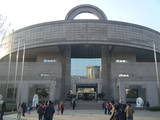
We then walked to the Shanghai Museum - a beautiful, huge art and artifacts museum that showcases China's cultural heritage, from jade, to calligraphy, to paintings, to furniture, to ceramics like porcelain, to clothing and ritual items - just beautiful items, and some were almost 3,000 years old. It was an incredible building, and below is it and the most amazing mask we saw that was about 2,000 years old.
We then walked a pedestrian mallway that was teeming with people. Of course, being foreigners and tall, every salesperson approached us to sell "purses and watches".
This led to the Bund - when Shanghai was opened to foreigners (it was one of the first, and few, international ports opened to foreigners in the early 1900's) there were French, British, and American quarters established, which were settled by each and the laws enacted within each were their own, not the Chinese. The British and Americans combined theirs but the French, being French, refused to cooperate. So distinctly non Asian areas grew up in Shanghai, with architecture to match. it is quite striking in an Asian city to see some suddenly French colonial building, but that is what the Bund is, along the river. I liked this picture because it seemed to show what Shanghai, and the Bund, are all about - East meets West, old meets new -
Along the Western side of the river is Shanghai's most recognizable landmark - the Shanghai Pearl. It is a tall, gleaming television tower built 15-20 years ago.
I'll leave you with a few random impressions:
- The beer generally sucks. It's very light. Nothing dark or with any real flavor. This is a problem for me, but after 1 day I'm figuring out how to get over it...
- There is a nationwide problem of spitting in the streets. So much so that before the World's Fair and Olympics they paid people to walk around and scold people who spit or cursed. But, so far, I haven't seen one person spit or blow their nose in the street. Progress!!
- It's the little things that make you realize you're in a foreign country. Fire extinguishers. Every building has a few. But they keep them sitting on the ground in the corners of rooms - bathrooms in the restaurant, corners of the museum. Not a big thing, but just strange when you're used to seeing them on a wall or in a case in the wall.
Sunday, April 3, 2011
I've Landed In China! (And Am Now Behind the "Great Wall"...)
I'm here! Fight was great - easy. Never had 14.5 hours go by so quickly. One bad James L. Brooks movie and another viewing of Harry Potter 7.
The biggest issue is The Great Wall. China doesn't allow Facebook or blogs. But Skype works, and through my mom's search I've found a workaround. I hope it sticks. There is a ton on the internet about this issue and how they randomly cut acces etc.
So - a few first impressions: lane striping and turn signals are optional (kind of like Boston), but horns are not. They are essential, apparently. Bikes aren't quite as common s I thought they'd be, but they don't seem to care about traffic laws very much.
Today is a holiday - Grave Sweeping Day (think memorial Day), so we'll see what happens. Most of our appointments cancelled for today because of it, but we do have 1 at the Shanghai Children's Hospital. Then the afternoon is ours - and we're hoping things are open. There is an art museum close by.
I'll post some pictures later!
The biggest issue is The Great Wall. China doesn't allow Facebook or blogs. But Skype works, and through my mom's search I've found a workaround. I hope it sticks. There is a ton on the internet about this issue and how they randomly cut acces etc.
So - a few first impressions: lane striping and turn signals are optional (kind of like Boston), but horns are not. They are essential, apparently. Bikes aren't quite as common s I thought they'd be, but they don't seem to care about traffic laws very much.
Today is a holiday - Grave Sweeping Day (think memorial Day), so we'll see what happens. Most of our appointments cancelled for today because of it, but we do have 1 at the Shanghai Children's Hospital. Then the afternoon is ours - and we're hoping things are open. There is an art museum close by.
I'll post some pictures later!
Thursday, March 31, 2011
Where the Hell Am I Going? (And Why Am I Going There??)
I've gotten quite a few questions about who I work for, why I'm going to China, what I'm going to do when I get there, and where I will be.
All excellent questions. I wish I knew the answers.
Who Do You Work For And What Do They Do?
I work for a 41 year old nonprofit - Children's HeartLink - which works to treat children with congenital heart defects (CHD's) in developing countries.
You should know that CHD's are the most common type of birth defect in the world and each year approximately 1 in every 120 children is born with one. In the United States and other developed countries CHD's are identified early - sometimes in utero and usually within moments of the child being born. Here, they are then whisked away and fixed within minutes of being born. There are certainly a group of children who have to have surgery a little later in life, but in the United States a child with CHD can and does live a full, normal life. Not so in developing countries.

All excellent questions. I wish I knew the answers.
Who Do You Work For And What Do They Do?
I work for a 41 year old nonprofit - Children's HeartLink - which works to treat children with congenital heart defects (CHD's) in developing countries.
You should know that CHD's are the most common type of birth defect in the world and each year approximately 1 in every 120 children is born with one. In the United States and other developed countries CHD's are identified early - sometimes in utero and usually within moments of the child being born. Here, they are then whisked away and fixed within minutes of being born. There are certainly a group of children who have to have surgery a little later in life, but in the United States a child with CHD can and does live a full, normal life. Not so in developing countries.
- First, the condition is most often undetected. The child may have breathing problems, may turn blue at times, or may faint. There are a wide array of symptoms and for doctors who do not have experience or knowledge with CHD's, they can be confusing and hard to pin down.
- Second, the specialized doctors and health care teams trained to identify and treat CHD's do not exist in nearly large enough numbers. In the United States there are more than 2,500 pediatric cardiologists who treat CHD's. In India, which has a population almost 4 times the size of the United States, there are estimated to be 35-40 pediatric cardiologists.
- Third, the coverage of treatment doe snot exist in most developing countries. While a relatively cheap surgery (not counting staff time, the cost is, on average, about $3,000), the lack of specialists with knowledge and lengthy recovery time make it an expensive condition to treat. (I should say that the universal coverage of CHD's in the United States is coming under fire in the new health care legislation and there is some question as to whether all instances will be covered moving forward...)
The ultimate goal of Children’s HeartLink is to empower local medical professionals to prevent and treat pediatric heart disease in their own populations so that every child can receive the care he or she needs.
What Are You Doing In China?
I will be visiting our 4 partner sites in China with our VP of International programs, Estelle Brouwer. At one (Jilin Heart Hospital in Changchun) there will be a full medical team visiting and I will get to see what they do to help our partner sites. I'll also get to see surgeries - little heart surgeries - first hand. At the other sites (Chengdu, Lanzhou, and Shanghai) we will meet with hospital administrators to share our developing model and talk about our relationship. We'll also be meeting with some other nonprofits that do work in China similar to ours and also meeting some potential funders.
Where Will You Be?
The short answer - all over the Central and Eastern part. I didn't realize it until the other day, but we're flying all over China. Which says a lot. China is the most populous and fourth largest country in the world. Yet the entire thing operates under 1 time zone. Crazy.
I will be in Shanghai (East coast), Changchun (NE), Chengdu (South central), and Lanzhou (central).

Subscribe to:
Posts (Atom)